Friday, February 10, 2012

AN ISLAND AMONG 7000 - SPECIAL BOHOL

How a community can flourish among less aware neighbors


Bohol is an island (or archipelago) in the central Philippines (Visayas). A tourist destination for many Europeans, Australians and ultimately, Russians, Chinese and Korean. The main spot is the Alona beach in Panglao Island. Bohol is best known for its interesting geological formation, small mountains called the Chocolate Hills and for the endemic presence of the Tarsier, one of the smallest primates on the planet.


Sunset in Alona beach: fancy tourism destination

Wonderful menu in Alona. But beware: this is not cheap!

In Panglao is possible to stay in a reasonable quality double bed room, very close to wonderful and pristine beaches, with the rent of a small scooter included and still make three meals of local food, all for less than $ 50 per day for 2 people.


We also observed that the inhabitants of the island and its large volatile population of tourists still rely heavily on external supplies. Despite of having fresh water rivers, the islands are dependent on stable regimes of precipitation.

Nature preserved along a good portion of Loboc River.


The urban areas of the island already have serious problems of water supply. In the first inn where we stayed, all the water was supplied daily by truck at a cost probably high, since there is no feasibility for public pumping systems.


Other recurrent problem in Asia:
There's no public drinking water!
Every drop has to be bought... The best solution we found to avoid the ultra-polluting plastic bottles is ALWAYS carry our own bottle and refill it whenever is possible.
It pollutes a lot less and is, in average, 20 (TWENTY!) times cheaper.

The nature is relatively preserved. Much of the main island is protected in the National Park where the Chocolate Hills are. But the big island's mangroves are under pressure by the culture of palm, a tree that grows in salty swamps. It is used for the production of edible oil and fuel that, despite its low quality, is consumed in Asia. The devastation by the housing industry also threatens natural systems of the island, mainly near the coast.

Natural Park, center of Bohol Island


The Palm being grown for cheap oil: Mangroves degradation.

The main town in the archipelago has an airport and seaport. We arrived there by ferry from Cebu City. The city, though small, is polluted and traffic is chaotic, common in Philippians cities.

Traffic jam in the small town of Tagbilaran, the bigger urban center in Bohol

But moving out of town, things change. The inhabitants of these islands show a special development. There are museums, study and conservation centers, environmental parks, etc. Even tourist enterprises, such as inns and hotels, often created and managed by foreigners, present here less environmentally degrading characteristics compared to other regions where foreigners invest only to exploit the resources to exhaustion, and leave.


The "Reggae" guesthouse in Panglao, owned by a French couple mainly made out bamboo and other local material.

Bohol is a tangle of beauty. Driving a motorcycle around the island is an adventure full of beautiful scenery and interesting places to visit like the Tarsiers' Preservation Park, the Chocolate Hills, the Butterflies Sanctuary, waterfalls, the Loboc village and its huge and interesting bridge to nowhere.


Wonderful landscape in the countryside, in Bohol


Very refreshing waterfall!


The Tarsier's center.

In daylight, Tarsiers are very sleepy and pretty much motionless.
At, night, very agile on the hunt for preys. At its birth, is about a thumbnail size.

The Tarsiers aren't kept in captivity.


The intriguing formation of the Chocolate Hills. Here the view of the Conservation Park.


The forming matter of the Chocolate Hills can be clearly seen in some cliffs in Bohol shore. Corals, shells and other sedimentation material of what was once, the bottom of the sea.


Floating restaurants in the charming Loboc Town.


An old historical building in Loboc, where the today's "bridge to nowhere" would have landed. 

The famous "Loboc Belvedere" or an obvious "bridge to nowhere".

This is actually the aborted construction of a bridge that would force de demolition on the historical building at the other side of this road. This pretended belvedere is surely world's strongest one, and possibly the most expensive too. 


In the Butterflies Sanctuary...


is possible to watch the breeding and ...


to grown butterfly wings!!


Despite we find all that interesting, what really amazed us were the sustainable initiatives in Bohol, such as organic farms, which are also development centers of social, cultural and arts. Projects that attract many young people in the community, promote local production, values knowledge and ancestral wisdom from the elders.

We visited the Bee Farm, a spectacle of awareness and sustainable development. A Philippine idealist, believing that something was very wrong in the social and ecological society where she grown up - in Hawaii (USA) - decided to return to her country of origin and "do something".

She set in a hut for six months on her parents' land which was in some way, abandoned. That was a contemplating and reflection time. She than idealized and conceived the Bee Farm, which is now a model farm, with over 200 employees who proudly show their talents to visitors and their areas of responsibility in the project.


In just over 10 years, they collectively developed a sustainable complex comprising beekeeping, garden, farm, hotel, convention center, restaurant, studio arts, weaving, kitchen and a fair trade shop with all sort of organic products. We could visit and fraternize with the hand-loom weavers, artists painting and sculpting.


View of the guesthouse in the Bee Farm


Canvases made out of coconut leafs, painted by Bee Farm's artists.

Bee Farm fairtrade shop.


Delicious organic products.


Great fun fraternizing with the weavers.


Wonderful fabrics come out of the hand-looms.

We also visited the organic garden with lots and lots of herbs, fruits and vegetables that go straight to the non less wonderful farm's restaurant.


Bee Farm's comprehensive garden: supplies all farms needs


Beautiful and yummy flower salad by Bee Farm


A wall, decorated with coconut shells: natural reinforcement and beauty to a building. 


We feel that in this island, things are thriving in this way because some smart people, imbued with ethics, holistic knowledge and courage to work outside the system, have got their small sustainable projects started, grew and inspired many others in the community to follow such initiatives. The air is filled with different social and environmental perspectives. People are more optimistic, sustainable and energetic!

It is also easy to see in the face of those who visit these farms - and they are many - a feeling of inspiration for their own lives. Maybe to carry out similar projects in their countries and even inspiration to reevaluate their lifestyles and goals. It was no different for us, we feel very inspired by the Bee Farm!


The good vibe of Bohol Island!


We hope that everyone could reflect a bit and feel inspired to seek for something new and optimistic for life, as we did!

A big sustainable hug to everyone!


Provocation: have you ever calculated your carbon footprint?

Tuesday, February 7, 2012

REREFLECTION ABOUT PHILIPPINES ENVIRONMENT


From the environmental point of view, Philippines has a lot to do. Although many Philippians seem to be aware of climate change, their explicit wish for consumption signs there is a lack of understanding about the interrelation through individual demand and it's impacts; just same as most of industrialized and developing countries inhabitants. 


In towns, a lot of vehicles


The Philippines cities we visited now seem very much like many occidental ones with regards to atmospheric, sound and visual pollution. Towns are crowded, jammed and dirty - we even recommend masks.

Little tinny island, over-crowed with houses with very poor sanitation conditions.

However, some aspects of culture preceding the western invasions remain, e.g., food. Philippians eat a lot of rice and fish.

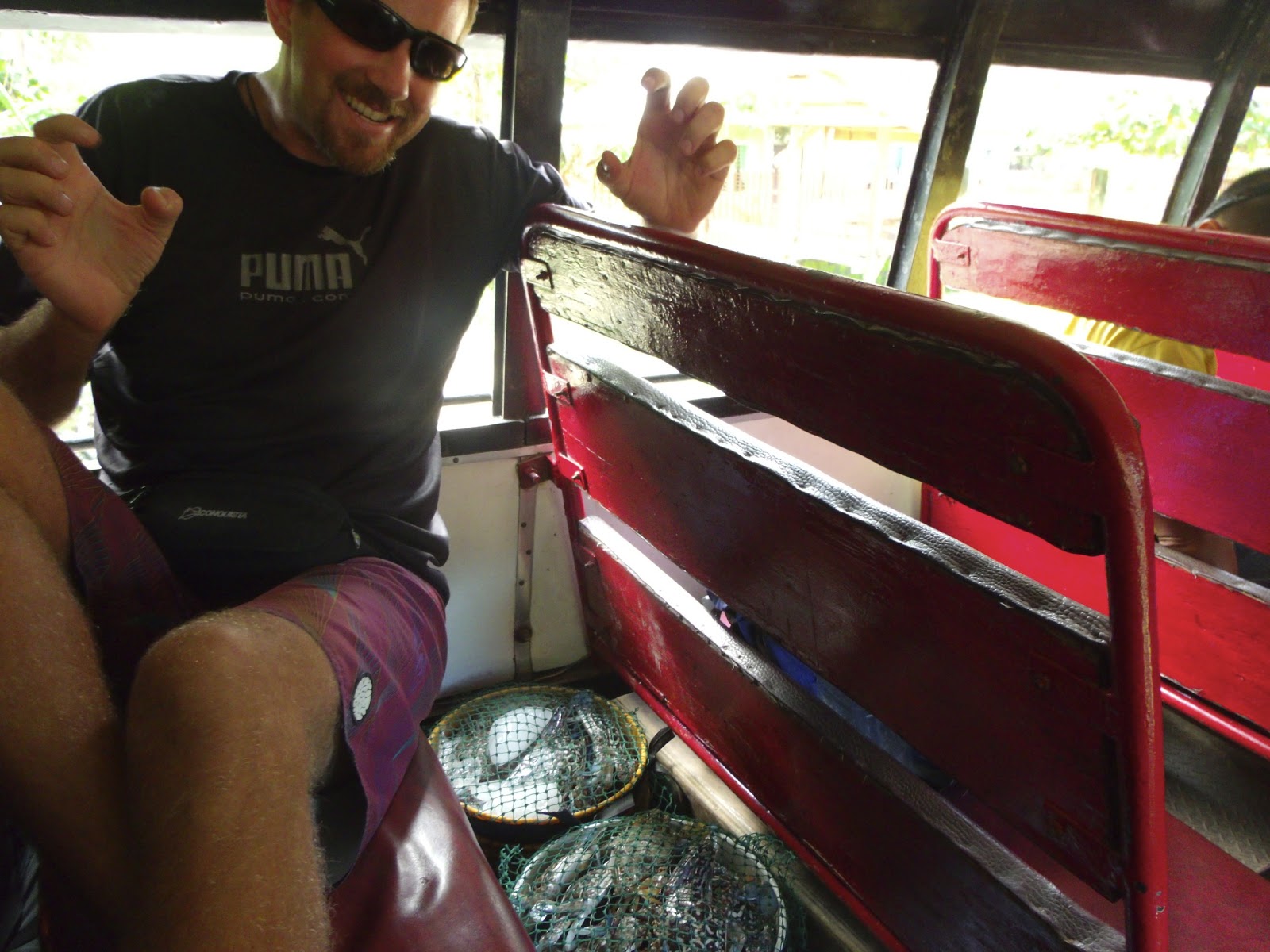
Intercity bus: sharing the seats with buckets filled up with alive crabs.


Motorbike are used to move all sort of odd items.
All our luggage on a motorbike!


Bike included in the guesthouse rate (USD 13.00 for double bed  room). But breaks maintenance  is to be carried  by the guest. Fun anyway.


Moving away from urban centers, traditional building technics are predominant, mainly on bamboo and palm leafs.  The nature is still exuberant, even though a relevant part or forests had already felled or, dynamite fishing is tolerated.

There is a population explosion happening here. About 100 million people live in Philippines and they're mostly young. This is more than 340 people per sq km (880 p/sq mi) spread among the 7000+ islands. Impressive. Even though Philippines is a Island country, we did not spot any local sailing boat or canoe. All passengers and cargo transportation are based on fossil fuel vehicles. Fast boat fares are normally pricy, so a common choice is to fly through islands.
On the other hand, another view of transportation in Philippines should be highlighted. We did travel a lot using as much as possible the most popular means. Jeepney is one of them. It's an extended jeep - legacy of the world war II: jeeps were left behind and soon enlarged to fit much more people - with entry by the back of the vehicle, two long alongside seats and wide windows, coverable with tarps. Very common. We enter one jeepney, payed USD 0.50 for about 40 km, and bet there was room for about 12 passengers. When the driver stopped collecting people, there was 32 inside! Shrank? A lot! But it was so much fun! It isn't rare to make good friends when these things happen.


Tricicle: can "fit" twelve people and a couple of bags.


We were so lucky and met Infinity's Captain Clemens and his family in Cebu Island! And of course, we adventured a tricycle ride together, on the way to some springs!


This is a Jeepney. We couldn't count how many on this one.

We were among 32 people in this jeepney! And made good friends during the journey! 

Tricicles: we could count up to 12 people in (and on!) a tricicle in Cebu City.


Also very common are the tricycles. A seats/trunks/roof-baggage sidecar attached to a motorcycle, in general a 125 cc. Again, we estimated, at first glance, a 4 people load vehicle. After a while, it's not difficult to spot 12 ( T - W- E - L - V- E ) Philippians in (and on) a single tricycle. Maybe some bags too.


Although all this seem to be dangerous, specially when traffic rules are "honk written", during our 2 months stay we did't witness any accident. Majority of drivers are careful and do not rush. At the end, the "overpacking" scores positively to Philippines on the way to refrain greenhouse gas once people give up comfort in benefit of energy usage.


Tricycle ride with Rhian, Infinity's Captain Clemens and Sage's daughter, the girl who was born  in May, 2011, in the deck of Infinity! She is amazingly cleaver and healthy! 
Garbage is an issue. Disposables utensils and excessive packaging for small fractions are largely used for any purpose. Little of disposed plastic is recycled. Every kind of food come packed in plastic bags; plastic gloves on to eat as many don’t use cutlery, plastic sausage to serve drinking water, plastic bag to cover the plate, plastic straws for every drink, plastic, plastic and plastic... argh!. Although typhoons and floods are more frequent every year, authorities keep postponing climate discussions and people stay consumption-driven.


When snorkeling in Malapascua we noted lots of plastic, algae and crow-of-thorns outbreaks, as the natural enemy is over-harvested.

Crown of Thorns outbreak - natural enemies over-harvested


Crown of thorns eat corals twice their size a day, what drastically threats coral reefs eco-system. Micro-particles of plastic mix to the plankton affecting all the sea food chain. Dynamite fishing also destroys a lot of the sea life. 
Now we are on a ferry heading to Bohol, island of chocolate hills, rice terraces, pristine beaches and the tarsier - 10 cm tall, the smallest primate in the world. Gotta see... 

Thursday, December 22, 2011

OUR OFFICE IN MALAPASCUA


Holidays in the "land of King Phillip" of Spain was just amazing. We were in Malapascua, a tiny island that you can walk the circumference in about 2 hours. In this small paradise we established our "office" for issuing the annual report, plan the next year and updating our blog.


Front beach WiFi


As work is not everything in life, we also enjoyed massages on the white sand beaches, snorkeling on turquoise lagoons, dancing at street disco, making new friends, swing in a hammock, walking through coconut farms... There are no cars in Malapascua, many motorbikes instead.


Cute little friend!


Beach massage.


Coconut farm

Malapascua does not have a port, pier or dock. All boats are anchored by the beach. The "shipyard" is also the sand.


"Sharkanoe"


Beach shipyard. Details of the Philippinean typical "spider" boats' structure.
The island is a great destination for diving. A variety of offers, such as manta rays and thresher sharks spotting, coral reefs, wreaks, are available in many Dive shops/Resorts. A dive starts from USD 35 and accommodation, as especial deals for divers, can be as cheap as USD 15 for a simple double bed cottage. For non certified divers, courses and PADI certification are available.

But, if the aim is to relax in a silent neighborhood, the option could be somewhere else. Very loud music and karaoke are widespread. Thousands of fight roosters equipped with broken clocks can ruin your rest any time of the day. However, we have to confess that, after a week or so, we've got used to all this and had a great time with locals. Whenever we heard a loud music - the "disco" - we followed the waves and had fun with this happy "Philippinos"!

Future Fight roosters eating with their mom.
When dinning, even having always minimized portions, we appreciated very much the food served in Eateries (we never heard this term before for a restaurant. Do you?). We can recommend Ging Ging Eatery: excellent value. For extreme shrank budgets and true local experience, try Mama & Jopay's eatery. For ultimate budget cold beer, stop by the Dick & Agnes's shop, in front of the main church. Can't miss.

Raquel, Agnes, Frederick and Francis, in their shop.
If you would like to find an "island in the island", The Other Place is the name o the place for good music, pool table, late evening excellent snack (ask for the burger) and a very warm welcome from Marco, Winwin and all the crew. Recommended!!!!


"The Other Place" crew and friends.
The owners Winwin on white shirt, Marco at the right.

Our friend Noa's (right) Birthday!


For Christmas and new year's eve, it's a tradition to roast a whole pig at the beach. Very interesting to see the preparation process. Basically, the main course arrives walking and after being cleaned, one single stick holds the whole pig over the ground fire. Somebody keeps turning it for about 5 hours. Manually. It is delicious! We also saw the most bizarre stick bbq's ever: squid, chicken skin, necks, feet, gizzard, liver, gut.


The local rum Boracay tastes good and is very cheap, US$ 2,5/bottle at a hotel bar. Drinks in returnable containers are much cheaper, which is a green incentive. There is no free drinking water in this country - do not drink water from the tap! But it’s easy to find water refueling spots for a reasonable price though.
All of these would be so much fun and perfect if we were not missing family, friends and black beans.

Saturday, December 10, 2011

ARRIVING IN THE PHILIPPINES


Philippines is the second largest archipelago in the world. It is made of approximately 7.000 islands, 300.000 sq km. It is an island nation, so boats and canoes play a major role in many people’s lives. Majority Roman Catholic, ethnically, Philippines is a melting pot. Islands are mountainous and seismically active. Earthquakes and  volcanic eruption are common. Climate is tropical and monsoonal.


Fort SAN PEDRO, proof of Hispanic and Catholic
occupation in the Philippines


But, before arriving here, we known very little about the country, e.g., the fact that Philippines is the place where the captain of first circumnavigation voyage was killed by natives on 1521. This history was written by Pigafetta, a italian crew member of the expedition financed by Spain and leaded by Ferdinand Magellan (Fernando Magalhães), the Portuguese who's decapitation was celebrated in Mactan Island.


Part of a big panel on the site where Magellan was
killed by Mactan's people 
Also, Back into childhood, a memory about Corazon Aquino, a Philippines' Democratic President who was been acclaimed by her People after a long period of dictatorship.
But arriving here, after a 40+ days cruise in a sailboat from Solomon Islands - almost 3 thousand nautical miles - the captain tried to approach the city of Cebu, in a bay where "should have a marina". It was around 3 am, in a very dark and foggy night and reefs were shown by the charts there. We waited - drifting - for the first daylight shimmer. Completely worn out after being driven the boat for a lot of hours (we can even remember how many), we didn't notice the bay we were was the "Magellan's bay". We actually arrived in Philippines right on the spot were, literally, he lost his head fighting the Mactan's Island chief, Lapu-Lapu, now reckon in Philippines as the first nation's hero. 


Lapu-Lapu statue, in Mactan Island


Fist Philippinean Hero plaque


Magellan's Death plaque.

"1866 - REINANDO YSABEL II" 

The above obelisc is located in the same site where LapuLapu is honored as the first Philippine's Hero. Seem to be without maintenance for long period and will be probably worn out by the weather.


Later, Raquel visited San Carlos University's Library where there's a original volume Pigafetta's 1st circumnavigation voyage diary, publication from XVI century.


This is a little about the history of this country that first had repelled european invasion, even though have had it's culture and resources later spoiled by invaders.


Praises, comments, adds and/or criticism are always welcome!


dfE team 

Wednesday, November 30, 2011

1st ANNIVERSARY!!! One year living simple and enjoying the beauty of our Planet


The Downshifting for Earth Project (dfE) has the honor to share with all our visitors, friends, family and supporters our happiness for the accomplishment of the first year living with very low carbon footprint, while traveling in Oceania and South East Asia!
According to objectives established by the project kick off, we have indeed reduced drastically our carbon emissions from about 30 to somewhat like 4 ton/year/person (t/y/p). However, it's still about 100% ABOVE our target of 2 t/y/p!
Even with our efforts to reach that level, there are aspects of traveling that we could not reduce so far, to mention, fossil fuel consumption - although traveling mainly in sailing boats, engine is used when wind is not sailable -, our dependence on the bank services, consumption of industrialized, non-seasonal and/or imported groceries and the very calling socialization with friends in bars and restaurants.

We came to the conclusion that, to reach the targeted carbon emissions, we should either travel much less (or shorter distances) or off set another 2 t/y/p to compensate the displacements. Thus, the planning for the next period will consider  these aspects.
As important as the concern on carbon emissions, we want share our joy on learning the great cultural aspects on the going. In places like New Zealand, Fiji, Vanuatu - consider the happiest people in the world, in 2006 -, Utupua Island in Solomons, we could experience living with the local communities that live sustained on values such as sharing, deep understanding and respect for the interconnection between human being and nature, simplicity, detachment to material, respect to the ancestors, truly hospitality. All that is commonly observed among most backcountry or islands inhabitants, who live all that with immense happiness. 
We understood the greatness of traveling in real contact with genuine local people, what we could call meaningful tourism, where real cultural sharing takes place instead the usual sights-inn tourism, commonly demanding high carbon activities.
To end this first year of downshifted life, we want to indeed acknowledge Infinity Sea Tribe - a true life experience -, every single person who had visited our blog and gave us any word of incentive. Also, we want warmly thanks to our friends and family, who unconditionally and enthusiastically supported our project. Due to all this we can consider the dfE Project is a great success!
Our special words all those who - either had fed back us or not - somehow felt encouraged by us to reflect about personal carbon emissions, or in any sort of life changing project. We just want to emphasize that anyone can do anything. First steps are to be aware, calculate your carbon footprint,  dream, than decide what kind of lifestyle would fit best to your beliefs! After that, be confident, coherent, plan and execute! It works!
As the summit of our 1st project anniversary, we'd like to share one of the most beautiful lessons we have learnt in this trip: The chief of the Sangava Village, in the remote Island of Emae, Shefa Province, in Vanuatu, wisely told us that, although Climate Change impacts are already happening on his Island and on his people - who have started being relocated due the sea level rise - he calls all his community to keep living in joy, without fear, just facing what has to be faced.
We found that lesson a tonic to our project and we agree that it fits any project or dream. Even when it requires paradigms breakage, extreme difficulties, the best attitude is face them all without fear, with joy.
We wish a much better treatment for the Earth, Nature and all Humans in 2012! 
And fair winds to every one!


YES! We'll be very happy with you comments, praises, criticisms, feed back. All welcome!


Sunday, October 23, 2011

Moving Planet in Utupua, Solomon Islands

As part of the 350.org campaign to build global grassroots movement to solve the climate crisis by moving the planet beyond fossil fuels, Infinity Expeditions organized week of activities in Utupua Island, Solomon Islands, starting on Sept 20th, 2011.

People from the Utupua Village of Nembao, aware of the safe level of CO2 in the atmosfere


Last June, in Sigatoka, Fiji,  5 Infinity crew members, joined the climate leadership workshop where 50 people were representing 13 Pacific countries — Palau, Papua New Guinea, the Marshall Islands, Kiribati, Nauru, the Solomon Islands, Federated States of Micronesia, Tonga, Vanuatu, American Samoa, Samoa, Fiji, New Zealand. We came out from this workshop more prepared to act against the climate crisis and committed to build up the Moving Planet on Sept, 24th on board Infinity.
Watch the video produced by Infinity Expeditions and dfE:


Moving Planet in Utupua
The event in Utupua mobilized approximately 500 people in four communities, Nembao, Aondo, Asumboa and Aveta with educational and cultural activities.
We promoted seminars on climate change awareness for 300 students at Patteson High School, disposal of plastic and batteries waste at Nembao Primary School e an overview about volunteer's home countries. Actions included plastic and batteries waste collecting, coral reef checks, solar panel repair and the manufacture of over 40 sails for traditional sailing canoes, supporting this fantastic and sustainable culture. Sailing canoe is the main way for transportation in Utupua. This is an inspiration for all of us since this modal is zero carbon emission.
Sept. 24th - Zero carbon emissions day
On Sept. 24th we had cold breakfast and lunch on board, paddled and walked to move.  We had dinner at Nembao village and concluded our day listening to guitar and angelical local young voices.
Pacific climate crisis
The effects of climate change on remote islands such as Utupua, bring us the urgency of lifting the rights of people and nature over the rights of polluters. It is unfair that these people, who have a very sustainable lifestyle — use sailing canoes and hike to travel, develop organic gardening, collect rain water and use solar energy only —  are facing a series of adversities not caused by themselves. 
Sea levels rising, more accelerated over the past five years, brings very real threats to life on the islands. Systematically, the reservoirs of fresh water and crops have became salty, coastal trees which are a natural protection against cyclones are being felled. Their houses have been washed out by high tides, what provokes the islanders to relocate. The increasingly frequent and potent cyclones destroy everything in their way.
The higher seas and oceans temperature and the significant increase of plastic particles  in plankton parts are degrading coral reefs and marine life - entire food chain - leading to their death.
These facts described above impacts in a very basic need of island people; their water supply, food chain and housing.
Our time in Utupua was very fruitful and led us to call up individuals, societies and governments to do their share and get the atmosphere's CO2 level back below 350 ppm.
Notes:

1. 350.org is building a global grassroots movement to solve the climate crisis. Online campaigns, grassroots organizing, and mass public actions are led from the bottom up by thousands of volunteer organizers in over 188 countries.

2. The number 350 means climate safety. To preserve our planet, scientists tell us we must reduce the amount of CO2 in the atmosphere from its current level of 39o+ parts per million to below 350 ppm. But 350 is more than a number—it's a symbol of where we need to head as a planet.


Crew members which joined the climate leadership workshopRaquel, Emmaline, Francis, Laura and Annelie
Kids at Asumboa Village


Greetings from dfE Team!

YES! We'll be very happy with you comments, praises, criticisms, feed back. All welcome